Title slide from the pitch deck, prepared for Road to Battlefield at the Silkroad Innovation Hub. · Watch on YouTube
Problem
Referral hiring is not an unproven idea. Large companies already treat it as their best channel and have industrialized it: internal referral platforms, structured bounties, and attribution that ties a hire back to the person who vouched for them. That tooling is enterprise software, bought or built by companies big enough to justify it.
Startups get none of it. The channel that works best is the one they have no product for, so the referral lives in a DM, the payout is a promise, and nobody holds a record of who vouched for whom. Everything that makes a referral valuable gets lost between the recommendation and the hire.
The timing sharpened it. Inside about eighteen months AI made applications effectively infinite, so a résumé stopped carrying much signal at exactly the moment teams got leaner and every hire started to matter more. The fallback is an agency, at the industry-standard fifteen to twenty-five percent of first-year salary. A personal vouch is the one signal that stays expensive to fake — and at startup scale, nobody had built the market for it.
Approach
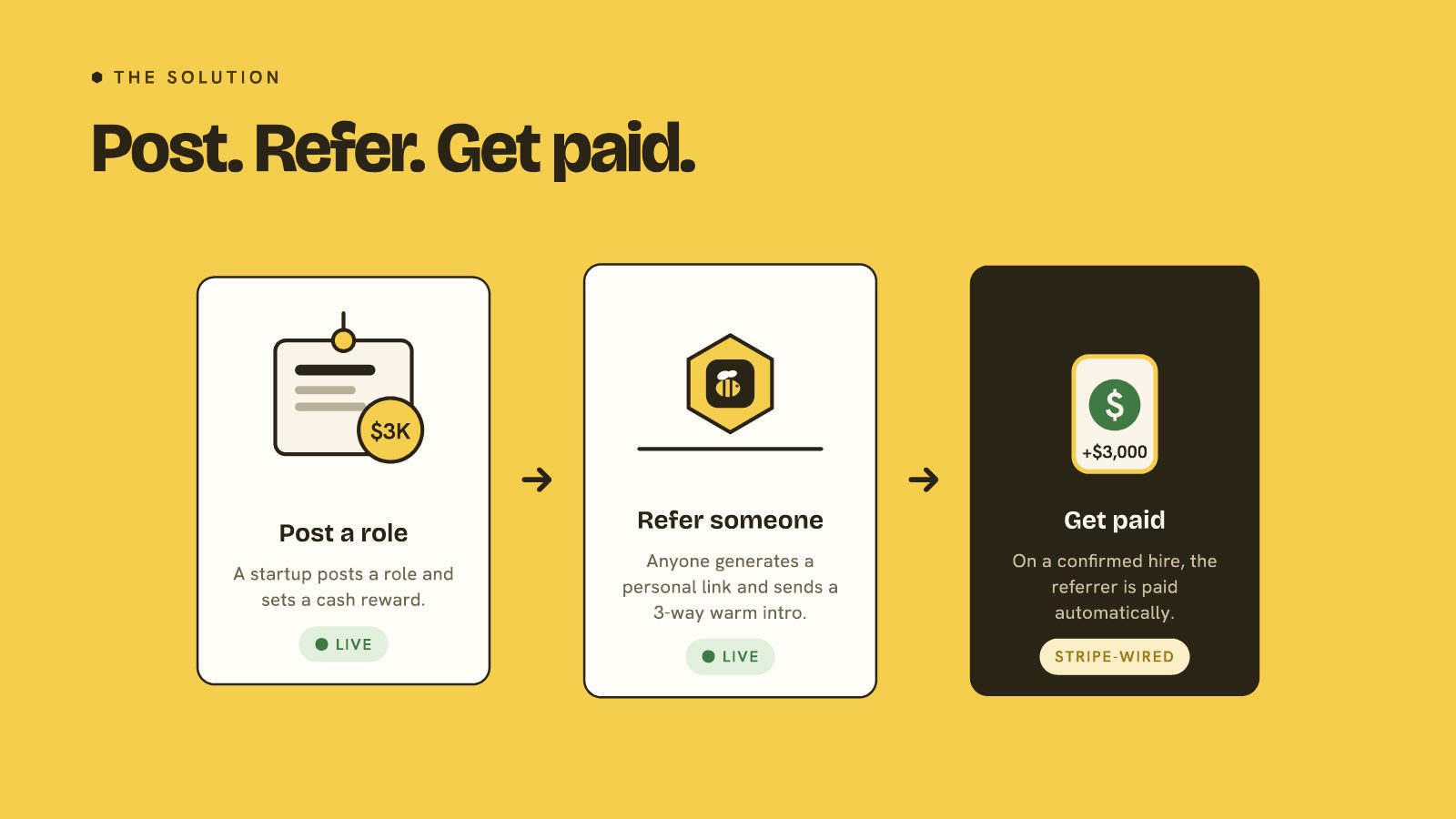
Post, refer, get paid. A startup posts a role and attaches a cash reward. A referrer puts someone forward — a person from their own network, or someone that network vouches for — by generating a personal link and making a three-way warm introduction. On a confirmed hire the reward becomes owed to the referrer automatically, held through an agreed cliff, then released. Because the employer sets the reward up front, everyone can see what an introduction is worth before it is made.
That constraint is the product, not a limitation on it. A referral only carries signal if the referrer actually knows the person, so the vouch has to be real rather than volume. Strangers selling strangers is the thing this replaces, not a cheaper version of it.
The business model runs on the same rail. In beta the company pays the referrer directly and Yellowbee charges the company a subscription, so the platform never sits in the middle of the money — the schema carries the subscription state and the gate that will read it, ahead of the billing it will enforce. Either way the reward is paid on an outcome rather than on activity, which is what separates it from a job board on one side and an agency retainer on the other.
The three-step flow, from the pitch deck.
Build
Next.js and Supabase, solo across the whole stack — schema, application, deployment and support. 249 merged pull requests and around 67,000 lines of TypeScript and SQL: 37 screens over 29 Postgres tables, with row-level security enabled on every one and 152 policies between them. Schema changes go in as migrations — 133 of them — so each one carries a commit and an author rather than a change somebody made in a console.
The rules that matter live in the database, not in the interface. A confirmed hire fires a trigger that writes exactly one payout, owed to the referrer, held until the cliff the employer set; releasing it is an RPC that checks who owns the role and refuses before that date. Doing it in Postgres makes it atomic and impossible to bypass from the client, which is where most referral programs quietly fail: somebody has to remember to pay, and eventually nobody does.
Attribution is the other thing that has to be exact, because it decides who gets paid. A signed-in candidate applying with a different email address used to have the application filed under their own account — a referrer's introduction disappearing on the way to the hire. The fix clamps attribution inside the submit path, a backfill detached the rows already wrong, and a CI tripwire now fails any pull request whose migration could reintroduce it.
Reward lifecycle — owed, held, released, paid — enforced by a trigger and an RPC, not by client code.
Row-level security on all 29 tables, 152 policies, applied through 133 versioned migrations.
Per-person referral links carrying attribution through to the hire, guarded by an invariant check in CI.
Résumés summarized by an LLM behind schema-constrained parsing that returns 502 rather than trusting a malformed shape.
Contact details never leave the server: the shared field type has no email column, so re-adding one fails the build.
21 Playwright specs over the paths that carry money or privacy — payout, attribution, message privacy, notifications.
Outcome
The platform is live, startups are posting real roles, and the first users are onboarding — 249 merged pull requests by one engineer with AI coding tools in the loop. The structural result is the one that matters: a vouch is now a record attached to a hire, which makes the payout mechanical and the quality signal measurable.